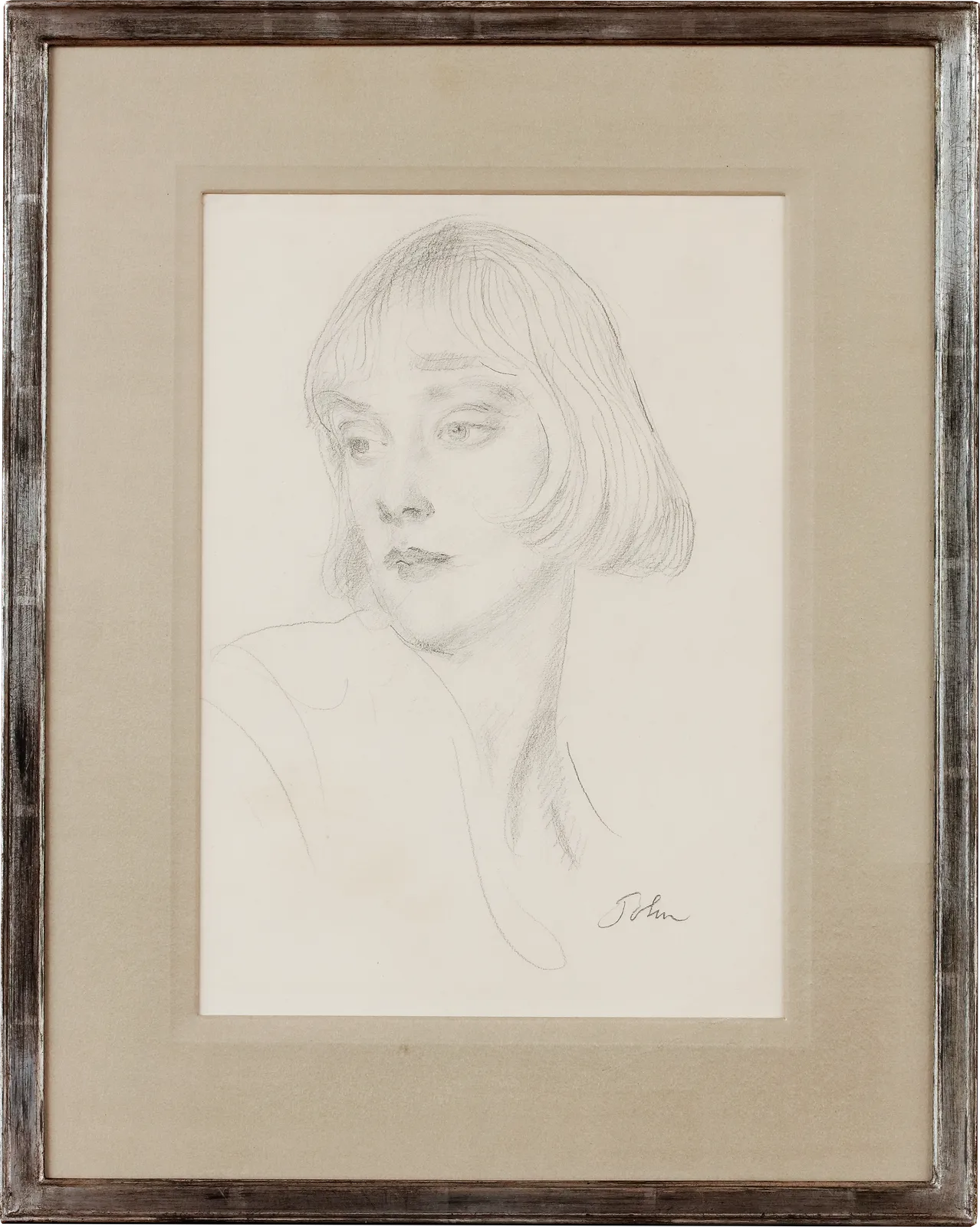
Augustus Edwin John
Iris Tree, c. 1919
Pencil on paper
13 1/4 x 9 5/8 in. (33.5 x 24.5 cm)
Signed ‘John’ lower right
Philip Mould & Company
This intimate sketch by Augustus John depicts the rebellious artist, playwright and modern woman, Iris Tree. Clearly of personal significance to Tree, this portrait remained in the collection of the...
This intimate sketch by Augustus John depicts the rebellious artist, playwright and modern woman, Iris Tree. Clearly of personal significance to Tree, this portrait remained in the collection of the sitters’ family for almost a century.
Few of John’s sitters could claim to rival him in their disregard for social convention. But Iris Tree was one such figure, and her life in many senses prefigured that of the modern-day liberated woman.
The youngest of three daughters of the actor-impresario, Sir Herbert Beerbohm Tree (1852-1917), Tree grew up surrounded by actors and artists. By the age of eleven she had sat for her first portrait, a work by William Nicholson; this was to be the first of many likenesses of Tree that were produced over the course of her lifetime by artists ranging from Vanessa Bell and Duncan Grant to Man Ray. Like John, they were drawn to Tree for her vivacious personality and striking appearance. She even had cameo role in La Dolce Vita, Federico Fellini’s cult film of 1960.
From the time of her arrival at the Slade School of Art in 1913, Tree was determined to defy the social and moral strictures of the day. Cutting her strawberry blonde hair into a short bob, she dressed in bold combinations of clashing colours and dresses, often designed by herself, cut to emulate peasant costume. She would attend parties with her friend Nancy Cunard – whose mother, Maud, Lady Cunard, paid host to the most elite of the London salons – wearing items from the wardrobe of collection of theatrical costumes and make-up that they had accumulated at their shared studio in Fitzroy Street, London. Independent and headstrong, Tree often made decisions without consulting her parents – something that was highly unorthodox for an unmarried woman of the time – failing, for instance, to inform her parents of her decision to move with Cunard to the Fitzroy Street Flat or even to tell them of her decision to marry her first husband, the painter and photographer Curtis Moffat (‘a bit of a sybarite’, in John’s view), in December 1916.[1]
Tree’s greatest accomplishment was as a poet. Aldous Huxley wrote in 1920 of her ‘genuine lyrical power, still young and unperfected, but already rich in achievement and richer in its future promise’.[2] Her poetic voice revelled in her free-spirited lifestyle. In a word picture written around the time that she went to the Slade, for example, Tree states that she had by this date had twenty-eight lovers ‘some more/some less’ and that, as well as having loved men, she had loved women. At its conclusion, she writes in terms that were remarkable for the time in their stark, unidealized honesty: ‘I am fat./ I am a soul./ I am an artist./ I am a wanton./ I am a hypocrite’.[3]
Tree first met Augustus John in the year after her arrival at the Slade. The pair met at a Thursday soirée thrown by the society hostess Lady Ottoline Morrell. Tree arrived wearing a dress adorned with blue and green ribbons that she had designed herself, mismatching stockings – one blue and the other green – and a wide-brimmed hat without a crown. Of John, she would later recall in an unpublished essay In Praise of Augustus John how:
‘at first meeting I experienced an immediate intimacy as if I was part of his landscape which has remained in my vision ever since. It has rounded hills, pale or slate-blue skies, grey rocks. Its people were angels dressed as peasants, women who baked crusty bread […] There was lavender in the coarse linen and brown or blue jugs of thick cream. Jars of wine were served under their vines to scowling men who drank into the night of love-making, singing, dancing.
But there’s another point more difficult to define except romantically for it was essentially romantic’.[4]
John, for his own part, was captivated by Tree. During sittings, he told her how he loved her ‘freckles and shadows’. One poem that he wrote to her ends with the lines: ‘with that old strange allure/ Voluptuously virginal and passionately pure’.[5] Indeed, such was John’s fondness for Tree as a model that she came to stand as a representative for the whole class of rebellious, gypsy-inspired women whom John so loved to depict. Christine Longford later remembered how ‘we bobbed our hair because Augustus John girls had short hair; and anyone who had red hair, like the picture of Iris Tree in Dublin [Dublin City Gallery, Hugh Lane Gallery], was lucky’.[6] John’s experiences with Tree were not limited to art. In his memoir, Chiaroscuro, he recalls how it was at a dinner party thrown by Tree’s then-husband Moffat that John first had a successful experience with hashish. ‘I had already tried smoking this celebrated drug without the slightest result’, he writes, but ‘Having helped myself to the first dose I had almost forgotten it when, catching the eye of Iris Tree across the dinner table, we were both simultaneously seized with uncontrollable laughter about nothing at all’.[7]
John drew and painted Tree on several occasions. Likely executed in c. 1919, John renders Tree’s features through delicate shadows in pencil. Her recognisable hair, cut into a short bob, asserts her position as a modern woman. This informal and evidently personal drawing in a nod to the friendship which developed between artist and sitter.
[1] John, A. (1924) Chiaroscuro: Fragments of Autobiography. London, p. 133.
[2] Fraser, I. (2014), ‘Tree, Iris [real name Iris Winifred Reine Daphne Beerbohm-Tree; married name Moffat, Ledebur] (1897-1968)’, Oxford Dictionary of National Biography. [online]. Available at: https://www-oxforddnb-com.lonlib.idm.oclc.org/view/10.1093/ref:odnb/9780198614128.001.0001/odnb-9780198614128-e-75839?rskey=4M2Jcf&result=1 (Accessed: 07/01/2020).
[3] Tree, I., quoted in Fielding, D. (1974) The Rainbow Picnic: A Portrait of Iris Tree. London: Eure Methuen Ltd, pp. 51-52.
[4] Tree, I., quoted in Fielding, D. (1974) The Rainbow Picnic: A Portrait of Iris Tree. London: Eure Methuen Ltd, pp. 52-53.
[5] Tree, I., quoted in Fielding, D. (1974) The Rainbow Picnic: A Portrait of Iris Tree. London: Eure Methuen Ltd, p. 53.
[6] Holroyd, M. (1996), Augustus John. London, p. 405.
[7] John, A. (1924) Chiaroscuro: Fragments of Autobiography. London, p. 134.
Few of John’s sitters could claim to rival him in their disregard for social convention. But Iris Tree was one such figure, and her life in many senses prefigured that of the modern-day liberated woman.
The youngest of three daughters of the actor-impresario, Sir Herbert Beerbohm Tree (1852-1917), Tree grew up surrounded by actors and artists. By the age of eleven she had sat for her first portrait, a work by William Nicholson; this was to be the first of many likenesses of Tree that were produced over the course of her lifetime by artists ranging from Vanessa Bell and Duncan Grant to Man Ray. Like John, they were drawn to Tree for her vivacious personality and striking appearance. She even had cameo role in La Dolce Vita, Federico Fellini’s cult film of 1960.
From the time of her arrival at the Slade School of Art in 1913, Tree was determined to defy the social and moral strictures of the day. Cutting her strawberry blonde hair into a short bob, she dressed in bold combinations of clashing colours and dresses, often designed by herself, cut to emulate peasant costume. She would attend parties with her friend Nancy Cunard – whose mother, Maud, Lady Cunard, paid host to the most elite of the London salons – wearing items from the wardrobe of collection of theatrical costumes and make-up that they had accumulated at their shared studio in Fitzroy Street, London. Independent and headstrong, Tree often made decisions without consulting her parents – something that was highly unorthodox for an unmarried woman of the time – failing, for instance, to inform her parents of her decision to move with Cunard to the Fitzroy Street Flat or even to tell them of her decision to marry her first husband, the painter and photographer Curtis Moffat (‘a bit of a sybarite’, in John’s view), in December 1916.[1]
Tree’s greatest accomplishment was as a poet. Aldous Huxley wrote in 1920 of her ‘genuine lyrical power, still young and unperfected, but already rich in achievement and richer in its future promise’.[2] Her poetic voice revelled in her free-spirited lifestyle. In a word picture written around the time that she went to the Slade, for example, Tree states that she had by this date had twenty-eight lovers ‘some more/some less’ and that, as well as having loved men, she had loved women. At its conclusion, she writes in terms that were remarkable for the time in their stark, unidealized honesty: ‘I am fat./ I am a soul./ I am an artist./ I am a wanton./ I am a hypocrite’.[3]
Tree first met Augustus John in the year after her arrival at the Slade. The pair met at a Thursday soirée thrown by the society hostess Lady Ottoline Morrell. Tree arrived wearing a dress adorned with blue and green ribbons that she had designed herself, mismatching stockings – one blue and the other green – and a wide-brimmed hat without a crown. Of John, she would later recall in an unpublished essay In Praise of Augustus John how:
‘at first meeting I experienced an immediate intimacy as if I was part of his landscape which has remained in my vision ever since. It has rounded hills, pale or slate-blue skies, grey rocks. Its people were angels dressed as peasants, women who baked crusty bread […] There was lavender in the coarse linen and brown or blue jugs of thick cream. Jars of wine were served under their vines to scowling men who drank into the night of love-making, singing, dancing.
But there’s another point more difficult to define except romantically for it was essentially romantic’.[4]
John, for his own part, was captivated by Tree. During sittings, he told her how he loved her ‘freckles and shadows’. One poem that he wrote to her ends with the lines: ‘with that old strange allure/ Voluptuously virginal and passionately pure’.[5] Indeed, such was John’s fondness for Tree as a model that she came to stand as a representative for the whole class of rebellious, gypsy-inspired women whom John so loved to depict. Christine Longford later remembered how ‘we bobbed our hair because Augustus John girls had short hair; and anyone who had red hair, like the picture of Iris Tree in Dublin [Dublin City Gallery, Hugh Lane Gallery], was lucky’.[6] John’s experiences with Tree were not limited to art. In his memoir, Chiaroscuro, he recalls how it was at a dinner party thrown by Tree’s then-husband Moffat that John first had a successful experience with hashish. ‘I had already tried smoking this celebrated drug without the slightest result’, he writes, but ‘Having helped myself to the first dose I had almost forgotten it when, catching the eye of Iris Tree across the dinner table, we were both simultaneously seized with uncontrollable laughter about nothing at all’.[7]
John drew and painted Tree on several occasions. Likely executed in c. 1919, John renders Tree’s features through delicate shadows in pencil. Her recognisable hair, cut into a short bob, asserts her position as a modern woman. This informal and evidently personal drawing in a nod to the friendship which developed between artist and sitter.
[1] John, A. (1924) Chiaroscuro: Fragments of Autobiography. London, p. 133.
[2] Fraser, I. (2014), ‘Tree, Iris [real name Iris Winifred Reine Daphne Beerbohm-Tree; married name Moffat, Ledebur] (1897-1968)’, Oxford Dictionary of National Biography. [online]. Available at: https://www-oxforddnb-com.lonlib.idm.oclc.org/view/10.1093/ref:odnb/9780198614128.001.0001/odnb-9780198614128-e-75839?rskey=4M2Jcf&result=1 (Accessed: 07/01/2020).
[3] Tree, I., quoted in Fielding, D. (1974) The Rainbow Picnic: A Portrait of Iris Tree. London: Eure Methuen Ltd, pp. 51-52.
[4] Tree, I., quoted in Fielding, D. (1974) The Rainbow Picnic: A Portrait of Iris Tree. London: Eure Methuen Ltd, pp. 52-53.
[5] Tree, I., quoted in Fielding, D. (1974) The Rainbow Picnic: A Portrait of Iris Tree. London: Eure Methuen Ltd, p. 53.
[6] Holroyd, M. (1996), Augustus John. London, p. 405.
[7] John, A. (1924) Chiaroscuro: Fragments of Autobiography. London, p. 134.
Provenance
The sitter;
Thence by family descent, until 2004;
With the Leicester Galleries, until 2006;
Acquired by the granddaughter of the sitter, from whom purchased 2021.
Exhibitions
Philip Mould Gallery, London, ‘‘Pose’: Artists & Models’, March 2026.