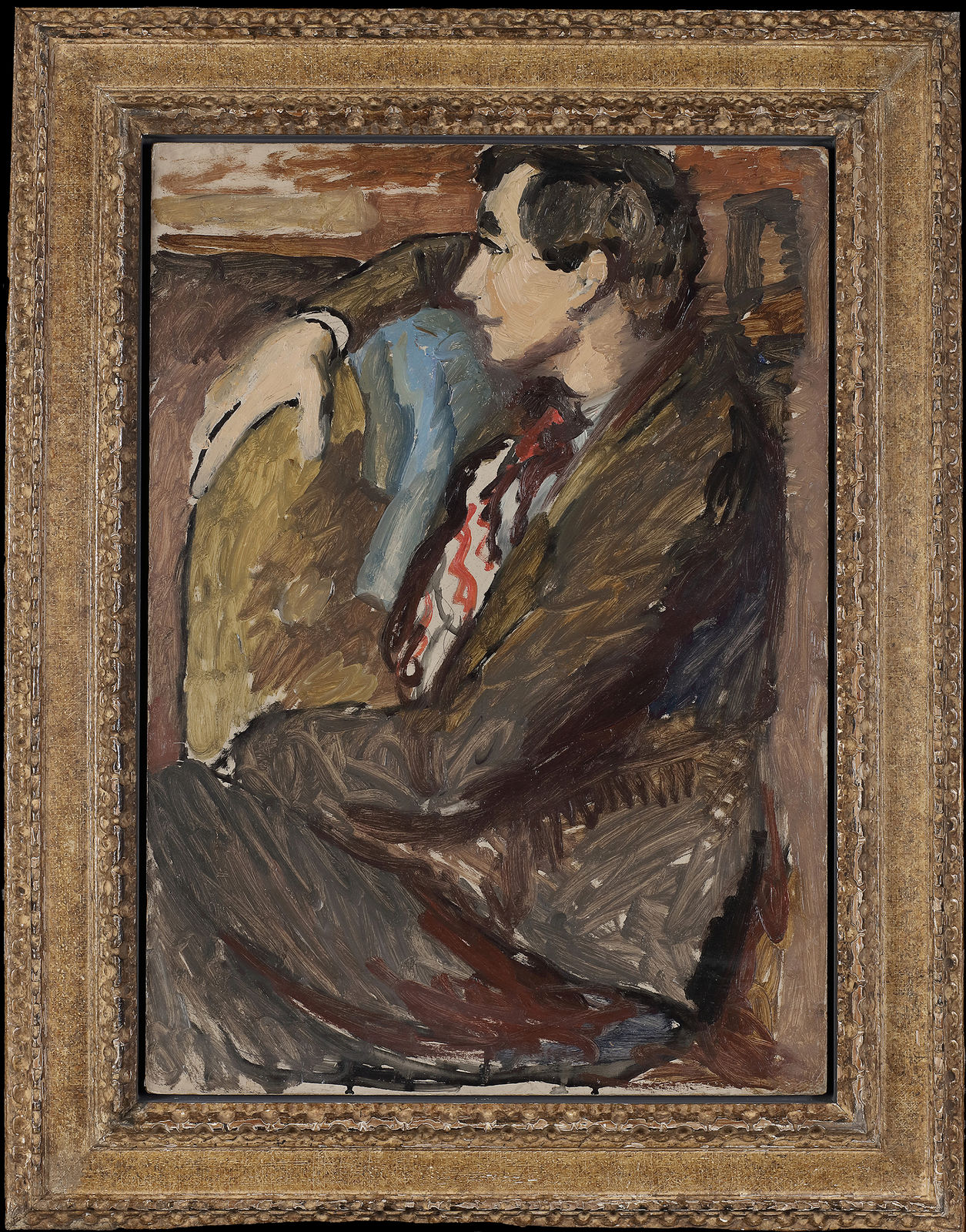
Duncan Grant
Portrait of Edward Wolfe, c. 1921
Oil on board
28 x 20 in. (71.1 x 50.8 cm)
Signed and inscribed ‘TEDDY WOLFE / DG’ on the reverse
Philip Mould & Company
Duncan Grant, Bloomsbury group bohemian, painted this portrait of the rising artist Edward ‘Teddy’ Wolfe, at the juncture just before he reached the height of his powers as a modern...
Duncan Grant, Bloomsbury group bohemian, painted this portrait of the rising artist Edward ‘Teddy’ Wolfe, at the juncture just before he reached the height of his powers as a modern artist. It was painted the year of Wolfe’s much anticipated return to London, after a period of severe illness which entailed his recovery in the warmer climate of his hometown, Johannesburg, South Africa. Wolfe returned to London invigorated and produced many of his best works throughout the 1920s. He would latterly become known as ‘England’s Matisse’ as a result of his vibrantly coloured portraits and still lifes.
Wolfe was born in Johannesburg in 1897, the only child to Eli Wolfe and Ruth Elizabeth Wedderburn. Eli died in 1905 and left the family in great financial difficulty due to his gambling habits. Ruth established a financial income through needlework and dressmaking and saved enough to pay for travel to Britain and modest rooms to rent in Bethnal Green, London, for two years. On their return, he received art lessons and was encouraged to return to London to pursue a career in the arts.
Wolfe moved back to London in 1916 and soon won scholarships to the Regent Street Polytechnic and the D’Aurban School of Dramatic Art. Thanks to his charming character and artistic talent, Wolfe found it easy to immerse himself within the artistic elite of the time. He attended the Slade School of Fine Art where he met artists such as Nina Hamnet, Ambrose McEvoy, members of the Bloomsbury group and frequented parties hosted by the likes of Augustus John.
Wolfe was introduced to the Omega Workshops by Hamnet, who referred him after she had grown tiresome of a particularly repetitive job which consisted of copying Fry’s designs for a large order of candle-shades.[1] Unsurprisingly, Wolfe found the job equally tedious and - in an attempt to divert his boredom – subtly altered some of the designs, much to Fry’s delight who proclaimed him ‘a perfect genius for candle-shades’ and promoted him to work on more senior designing jobs.[2] Fry even bought some of his drawings for his own collection.
In 1919, Wolfe caught a severe case of influenza during the epidemic. He flew back to South Africa to recover and later staged a one-man show at the Leon Levson Gallery in 1920 after regaining his health. With the funds from this exhibition, Wolfe travelled back to London in 1921 – the same year that this portrait was painted. Although this work is dated ‘1920’ on labels on the reverse, it is likely that this is a later, erroneous suggestion, perhaps by Grant himself who often dated his early work incorrectly in later life. The portrait was consigned to the dealer Anthony d’Offay from whom it was acquired by Wolfe in 1978.
Although Wolfe was associated with contemporary movements and groups, such as the Bloomsbury group, he never fully devoted himself to one group or style. His biographer, John Russel, astutely observes that Wolfe ‘retained a quality of the outsider-by-choice’.[3] It is perhaps this characteristic which so intrigued Grant. Early on in their friendship, Grant allegedly instigated an affair with Wolfe, who politely rejected him. Nevertheless, the pair became lifelong friends and the present portrait is a testament to their close relationship.[4] Grant’s contemporaries often commented on his ‘special gift for painting portraits’, particularly portraits of those he loved; ‘there has always been a very serious and searching element in Grant’s character, an aspect of his mind which shows itself in the best of his portraits’.[5]
[1] Hooker, D. (1986), Nina Hamnet: queen of bohemia. London: Constable, p. 103.
[2] Fry, R. quoted in Shone, R. (1993) Bloomsbury Portraits: Vanessa Bell, Duncan Grant and their Circle. London: Phadion Press Limited, p. 162.
[3] Russel, J., (1986) Edward Wolfe. London: Trefoil books, p. 5.
[4] Russel, J., (1986) Edward Wolfe. London: Trefoil books, p. 18.
[5] Clutton-Brock, A., (1959) ‘Round the London Art Galleries’, The Listener. May 21, 1959, Vol. 61, Issue: 1573.
Wolfe was born in Johannesburg in 1897, the only child to Eli Wolfe and Ruth Elizabeth Wedderburn. Eli died in 1905 and left the family in great financial difficulty due to his gambling habits. Ruth established a financial income through needlework and dressmaking and saved enough to pay for travel to Britain and modest rooms to rent in Bethnal Green, London, for two years. On their return, he received art lessons and was encouraged to return to London to pursue a career in the arts.
Wolfe moved back to London in 1916 and soon won scholarships to the Regent Street Polytechnic and the D’Aurban School of Dramatic Art. Thanks to his charming character and artistic talent, Wolfe found it easy to immerse himself within the artistic elite of the time. He attended the Slade School of Fine Art where he met artists such as Nina Hamnet, Ambrose McEvoy, members of the Bloomsbury group and frequented parties hosted by the likes of Augustus John.
Wolfe was introduced to the Omega Workshops by Hamnet, who referred him after she had grown tiresome of a particularly repetitive job which consisted of copying Fry’s designs for a large order of candle-shades.[1] Unsurprisingly, Wolfe found the job equally tedious and - in an attempt to divert his boredom – subtly altered some of the designs, much to Fry’s delight who proclaimed him ‘a perfect genius for candle-shades’ and promoted him to work on more senior designing jobs.[2] Fry even bought some of his drawings for his own collection.
In 1919, Wolfe caught a severe case of influenza during the epidemic. He flew back to South Africa to recover and later staged a one-man show at the Leon Levson Gallery in 1920 after regaining his health. With the funds from this exhibition, Wolfe travelled back to London in 1921 – the same year that this portrait was painted. Although this work is dated ‘1920’ on labels on the reverse, it is likely that this is a later, erroneous suggestion, perhaps by Grant himself who often dated his early work incorrectly in later life. The portrait was consigned to the dealer Anthony d’Offay from whom it was acquired by Wolfe in 1978.
Although Wolfe was associated with contemporary movements and groups, such as the Bloomsbury group, he never fully devoted himself to one group or style. His biographer, John Russel, astutely observes that Wolfe ‘retained a quality of the outsider-by-choice’.[3] It is perhaps this characteristic which so intrigued Grant. Early on in their friendship, Grant allegedly instigated an affair with Wolfe, who politely rejected him. Nevertheless, the pair became lifelong friends and the present portrait is a testament to their close relationship.[4] Grant’s contemporaries often commented on his ‘special gift for painting portraits’, particularly portraits of those he loved; ‘there has always been a very serious and searching element in Grant’s character, an aspect of his mind which shows itself in the best of his portraits’.[5]
[1] Hooker, D. (1986), Nina Hamnet: queen of bohemia. London: Constable, p. 103.
[2] Fry, R. quoted in Shone, R. (1993) Bloomsbury Portraits: Vanessa Bell, Duncan Grant and their Circle. London: Phadion Press Limited, p. 162.
[3] Russel, J., (1986) Edward Wolfe. London: Trefoil books, p. 5.
[4] Russel, J., (1986) Edward Wolfe. London: Trefoil books, p. 18.
[5] Clutton-Brock, A., (1959) ‘Round the London Art Galleries’, The Listener. May 21, 1959, Vol. 61, Issue: 1573.
Provenance
The artist;
Anthony
d’Offay, London, 1970s;
Acquired from the above by the sitter Edward Wolfe, 1978;
Fosse Gallery, Gloucestershire, 1984;
Private Collection, UK;
Philip Mould Gallery, London, acquired from the above.
Exhibitions
Thomas Agnew & Sons, London, ‘British Exhibition’, 1975, no. 38;Charleston, Firle, ‘The Faces of Bloomsbury’, 7 February–14 April 2024;
Philip Mould Gallery, London, ‘''Pose’. Artists & Models', March 2026.
Be the first to hear about our available artworks
* denotes required fields
We will process the personal data you have supplied in accordance with our privacy policy (available on request). You can unsubscribe or change your preferences at any time by clicking the link in our emails.