Christopher Wood
Man with Cards , 1925
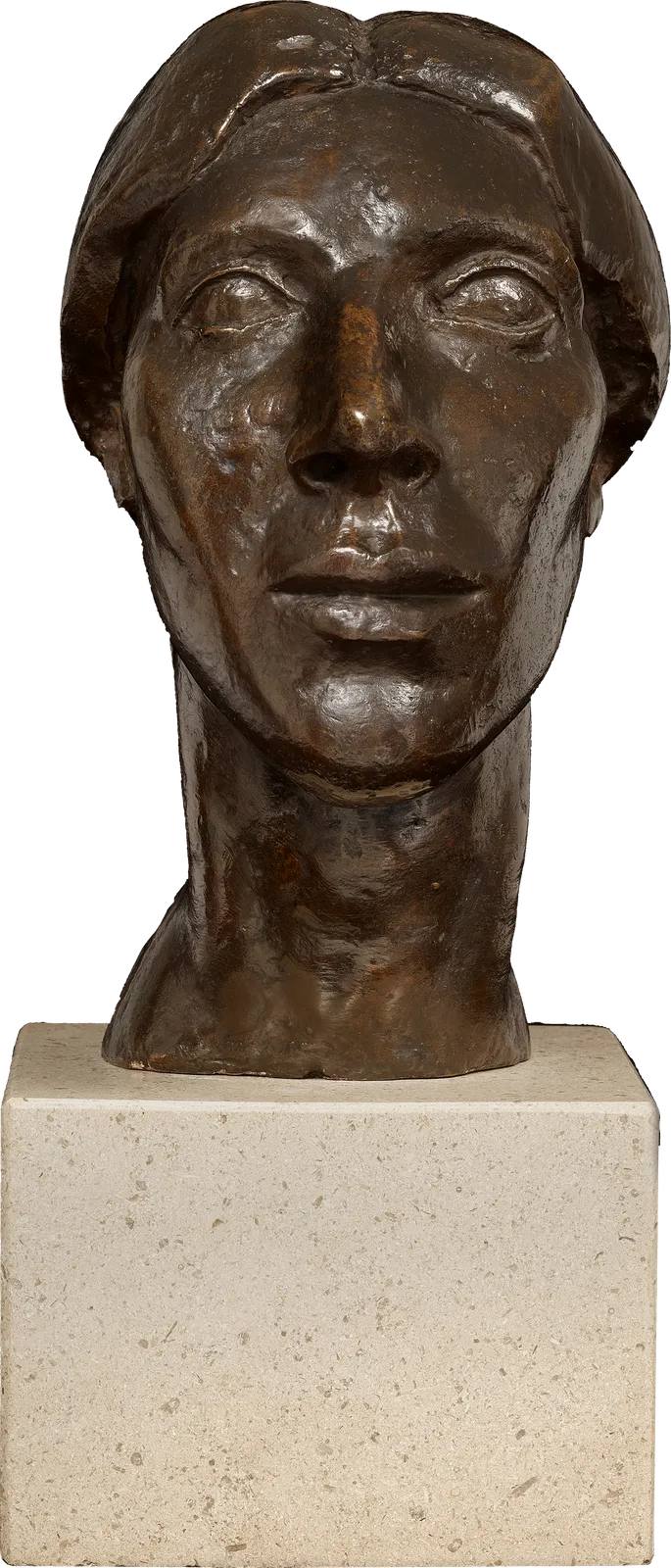
Frank Dobson has been described, alongside Henri Gaudier-Breszka (1891-1915) and Jacob Epstein (1880-1959), as one of the most significant figures in the development of twentieth-century British sculpture, and among the chief forerunners of the sculpture of Henry Moore (1898-1986) and Barbara Hepworth (1903-1975).
This recently discovered bronze head of his sister-in-law, the Cornish artist Mary Jewels (1886-1977), evokes the febrile climate of artistic experimentation of the Cornish village of Newlyn. Dobson had lived in Newlyn before the First World War and returned there in 1919, the year before this bronze head was made. When there, he soon formed a close friendship with Cedric Morris (1889-1982) who assisted Dobson in his workshop and also modelled for a bust in lead (previously with Philip Mould & Co.).
Dobson was experimenting with a variety of medium at this date including plaster, stone, lead and bronze as well as painting and drawing prolifically. This curiosity was clearly contagious and it wasn’t long before Mary, already part of that social circle, began to try her hand at painting. Mary initially asked Morris for guidance – his brash, confident style had caught the attention of a number of his peers in Newlyn – although Morris, recognising in her a fierce independence of spirit, refused her request and instead handed her four tubes of paint and a canvas and told her to cover it by the end of the day.[1] It was for this reason that she could later declare that ‘I am influenced by no-body and entirely self-taught. A true Celt, loving my Cornwall’.[2] Jewels’s approach to the subject matter of her native Newlyn was singular and deliberately untrained; in this, her work bore similarities with the other naif of Cornish art, Alfred Wallis, whom she met but found uncongenial.[3] With Wallis, she exerted a powerful influence over the young artists Ben Nicholson (1894-1982) and Christopher Wood (1901-1930), who discovered the latter artist in 1928, by which point Augustus John (1878-1961) was already praising the ‘intensity’, ‘blaze’ and ‘place-magic’ of Jewels’s work in British Vogue.[4]
Born in 1886, the same year as Jewels, Dobson had come to sculpture relatively late in his artistic development. It was only after seeing the seminal 1910 exhibition, Manet and the Post-Impressionists, curated by academic and taste-maker Roger Fry (1866-1934), that Dobson realised the expressive potential of modern sculpture. He had already, by his own account, had his horizons entirely transformed by his first encounter with the Impressionists, and this new exposure to the works of artists such as Paul Gauguin (1848-1903) – with his interest in the potentialities of African and Oceanic art – was to cause a similarly radical shift in his outlook. Dobson later described the exhibition as ‘just an explosion – the demolition of all the art-forms I had come to know’ that meant that ‘anything was possible’.[5]
This bust, which can be seen in a photograph of Dobson in his studio dating to the 1920s, bears the hallmarks of this transformative experience. Mask-like, with a powerful, seeking gaze – appropriate to a portrait of an artist – it demonstrates Dobson’s growing fascination with formal qualities of sculpture, which stemmed from the art of the “primitives”. Dobson evidently took great delight, moreover, in the silhouette of Jewels’s commanding profile, which was also stressed in photographs of the artist. In this, it prefigures many of the artist’s greatest works, including his 1922 portrait of Sir Osbert Sitwell (1892-1969). An intimate work, only two casts are known, one given to Dobson’s wife, and the sitter’s sister, Cordelia - the present work is one of these casts.
[1] Hendra, L. (2018) Cedric Morris: Beyond the Garden Wall. London: Philip Mould & Company, p.14
[2] Wilkins, D. (2017) The Alfred Wallis Factor: Conflict in Post-War St Ives Art. Cambridge, p. 92
[3] Dobson, F., quoted in Ruhrmund, F. (1977) Cornish Life. Vol. 3. Cornwall.
[4] John, A., quoted in Hardie, M. (1994) 100 Years in Newlyn: Diary of a Gallery. Newlyn: Patten Press, p. 79
[5] Dobson, F., quoted in Jason, N., and Thompson-Pharoah, L. (1994) The Sculpture of Frank Dobson. London: Lund Humphries Publishers, pp. 23-24.
The
Fine Art Society, London, by 1981;
David Buckman Esq;
Gorringes, Lewes, 26 June 2018, lot 607;
Philip Mould & Company, acquired from the above.
Harris Museum and Art Gallery, Preston, True and Pure Sculpture: Frank Dobson (1886–1963). 5 September – 3 October 1981;
Philip Mould Gallery, London, ‘‘Pose’: Artists & Models’, March 2026.
Neville Jason, Lisa Thompson-Pharoah, The Sculpture of Frank Dobson (London, 1994), Cat. 14, No.2;
Hopper, R., 1981. True and Pure Sculpture: Frank Dobson (1886–1963), exhibition catalogue, 4 July – 9 August 1981, Kettle’s Yard, Cambridge; Harris Museum and Art Gallery, Preston; Ferens Art Gallery, Hull; City Museum and Art Gallery, Birmingham. Suffolk: Lavenham Press Limited, no. 26.

* denotes required fields
We will process the personal data you have supplied in accordance with our privacy policy (available on request). You can unsubscribe or change your preferences at any time by clicking the link in our emails.