Simon Bussy
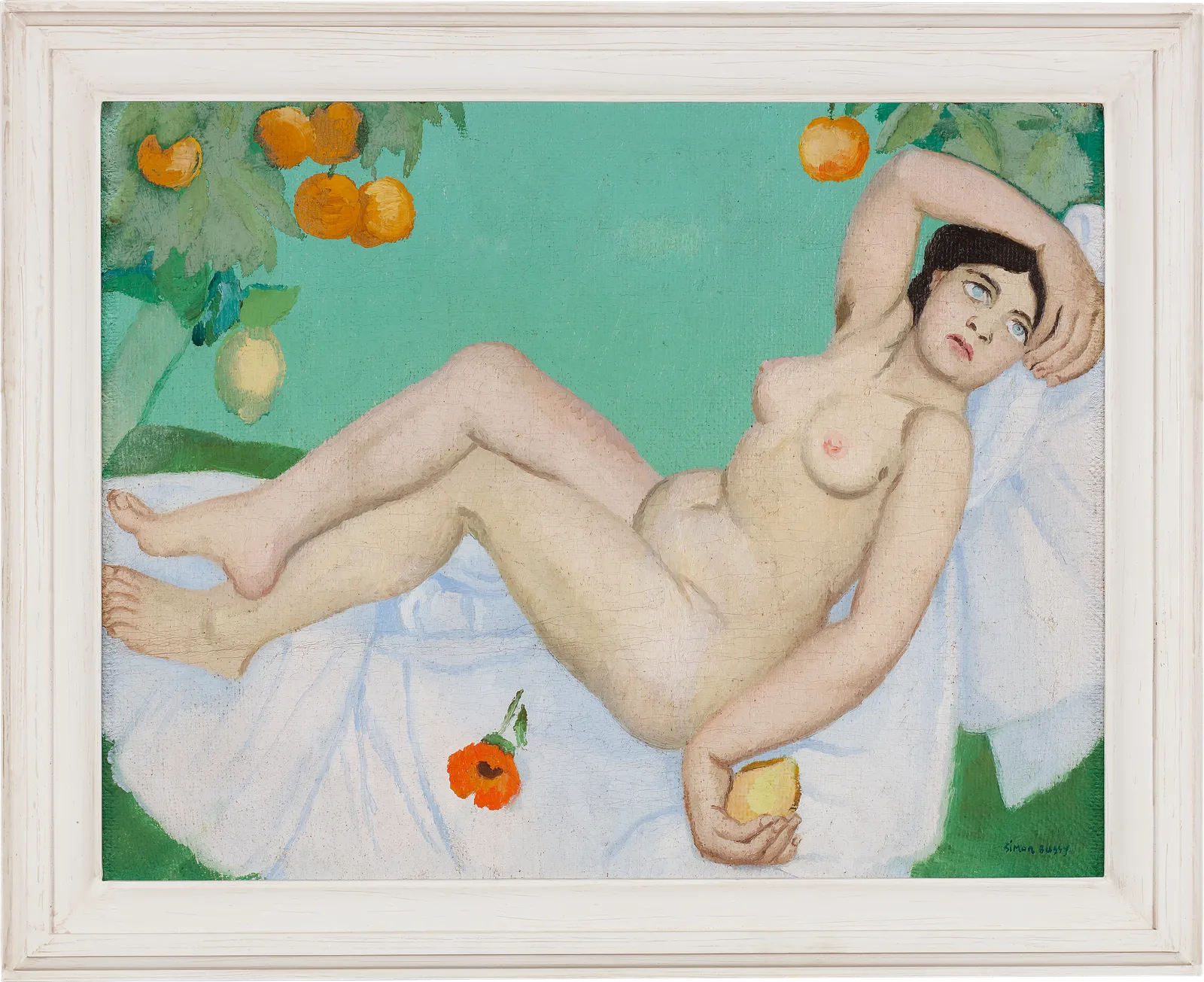
Simon Bussy was a friend of Henri Matisse and a highly talented artist who is best remembered for his colourful, simplified depictions of flora and fauna in pastels. The present work, captured in his characteristically vivid palette, is a rare early example of Bussy’s work in oils and depicts the artist’s wife Dorothy in the guise of a reclining Venus. Dorothy was the sister of Lytton Strachey, and it was through her that Bussy became associated with the Bloomsbury group, one of the twentieth century's most enriching and enduring cultural circles.
This work was painted at Bussy's home La Souco in Roquebrune, a picturesque haven of colour and light which influenced many of Bussy’s large figure paintings from this date.[1] Compositionally, the present work shares similarities with two earlier, more traditional paintings by the artist, both depicting a young woman reclining on swathes of white fabric; La Fontaine De La Sirene [fig. 1], exhibited at the 1910 Salon d'Automne and Lourd Crépuscule D'été [fig. 2], which was also painted at La Souco. The orange trees in the background are one of the main identifiers of this location and were often remarked upon by those who visited, including Lytton, who described the ‘brilliant orange and lemon trees’ to Duncan Grant.[2]
The house was likely a wedding gift from Dorothy’s father after the couple married in 1905 and it soon became an intellectual hub where the artistic and literary elite from both sides of the channel convened and exchanged ideas. Lytton, Duncan, Roger Fry, Vanessa Bell, and Virginia Woolf all frequented La Souco and its place within the history of Bloomsbury is as significant - if not as well renowned - as 46 Gordon Square, Charleston Farmhouse, and Ham Spray.
Dorothy was a respected author and published her novel Olivia through the Hogarth Press with the help of Virginia Woolf. Olivia openly explored themes of lesbian love, breaking with societal norms of her time, whilst her work as a translator included bringing André Gide's writings to the English-speaking world. Her progressive views and contributions to literature aligned sympathetically with the bloomsbury’s group’s progressive stance on sexuality and positioned her as a notable and unconventional figure within twentieth-century literature.
Simon Bussy’s impact on the Bloomsbury group - and in particular on the art of Duncan Grant - is often overlooked but was certainly acknowledged by the latter who heralded the older Frenchman as ‘Mon Maitre’ - ‘My Master’. Grant and Bussy would often visit the National Gallery together to copy Old Masters and in 1935 Grant reminisced; ‘His lessons remain with me as the best I have ever received.’[3] Indeed, one of Grant’s most treasured possessions, which is now in the studio at Charleston, was a set of pastels that once belonged to Matisse and were then gifted to Grant by Bussy.
In this work colour and scale collide to tackle what must be one of the most enduring subjects within Western art – the reclining nude. Unlike many of his predecessors who pursued a more sensitive and academic approach to the female nude, in this work, Bussy emphasises strong line and colour as a means of expression. The painting was evidently considered an important work within the artist’s oeuvre and was kept within the family until it was sold at auction in the mid-twentieth century.
[1] Many of these early large-scale works were exhibited at the Salon d'Automne from 1905 until around 1911.
[2] Lytton Strachey, 1906, quoted in Olivia Garnett, ‘The Early Work of Simon Bussy 1890-1912’, Dissertation, submitted for the degree of M.A. Courtauld Institute, 1980, p. 15.
[3] Duncan Grant, quoted in Frances Spaulding, (1997) Duncan Grant: A Biography. London: Chatto and Windus, p.25.
Provenance
The Artist;
Dorothy Bussy (née Strachey) (the artist’s wife);
John Strachey until 1965, by family descent from the above;
Sotheby’s, London, ‘Paintings and
Pastels by Simon Bussy: The Property of John Strachey, Esq.’, 9 December
1965, lot 60.
Lord and Lady Neill and thence by family descent;
Bonhams, London, 30 June 2021, lot 39;
Philip Mould Gallery, London, acquired from the above.
Exhibitions
Philip Mould Gallery, London, ‘‘Pose’: Artists & Models’, March 2026.