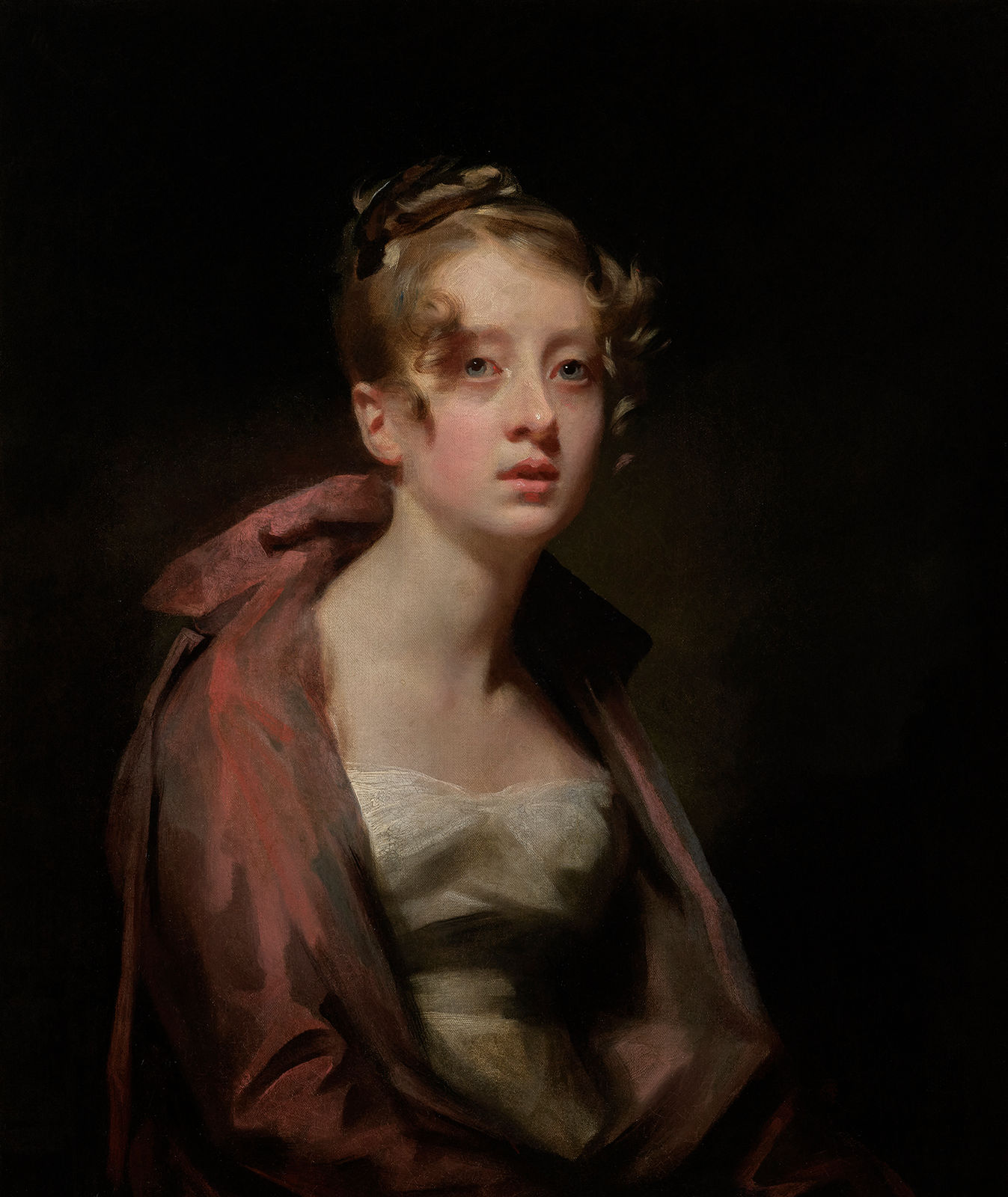
 Fig. 1
Sir Henry Raeburn
Fig. 1
Sir Henry RaeburnMargaritta Moncrieff, c. 1814
Oil on canvas
76.50 x 64.00
Scottish National Gallery
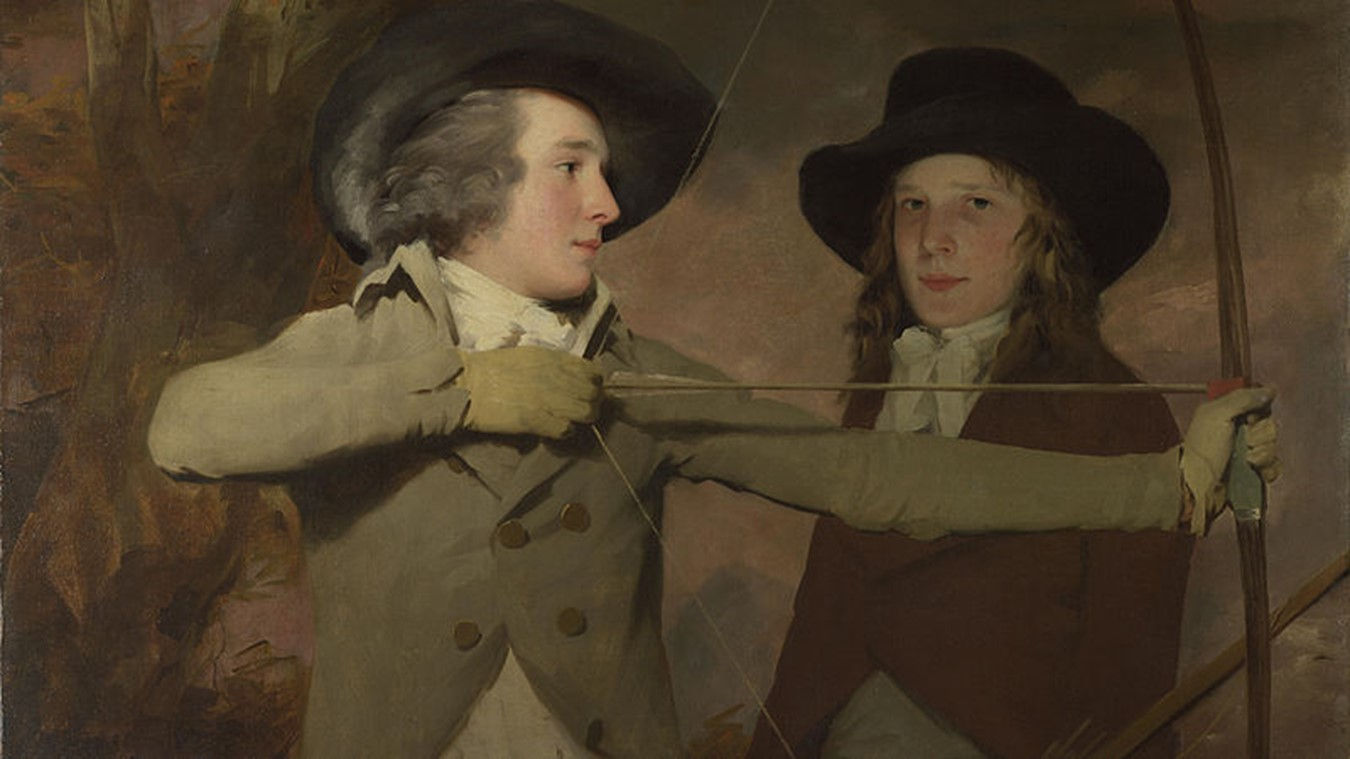 Fig. 2
Sir Henry Raeburn
Fig. 2
Sir Henry RaeburnThe Archers, c. 1787-92
Oil on canvas
110.5 × 123.6 cm
The National Gallery, London
Sir Henry Raeburn PRSA
Further images


Romanticism and realism collide in this exemplary work by Sir Henry Raeburn. Painted towards the end of his career this portrait perfectly speaks the words of Scottish writer John Brown, who famously said of Raeburn: ‘He paints the truth, and he paints it with love.’[1]
Painted in broad, confident brushstrokes against a dark background, the young sitter glances out at the viewer with an expression that oscillates between sensuality and apprehension. The portrait was painted around the time of the sitter’s marriage in 1820 – a seminal moment in the young woman’s life that only a portraitist of great skill and sensitivity could convey. Sarah Wordsworth was the daughter of Anne Poole and Samuel Wordsworth, about whom very little is known, and on 22nd February 1820, at the age of twenty-three, she married a barrister named Robert Hartshorn Barber (1783-1870) in Edinburgh. The bright-eyed youth of the sitter expressed so deftly by Raeburn was soon to be challenged by the realities of life and over the two decades that followed Sarah bore seven children – a significant number for a middle-class household, even in those times. Indeed, the tough reality of childbirth and its associated risks may well have occasioned the preservation of Sarah’s likeness in this portrait, which was a treasured heirloom and remained in the family’s possession until as recently as 1980.
Unlike many of his contemporaries who favoured idealism over individuality, in this work, Raeburn successfully imparts humanity through a natural posture and porcelain-like treatment of the neck and face, which is subtly framed by two locks of falling hair. The clarity of the features is foregrounded by the summary, brisk treatment of the crimson pelisse which is turned back to reveal the fashionably high-waisted dress with low, square-shaped décolletage. In its almost daring informality, the costume enhances the directness of the sitter’s gaze and creates a near-palpable aura of identity and self-awareness.
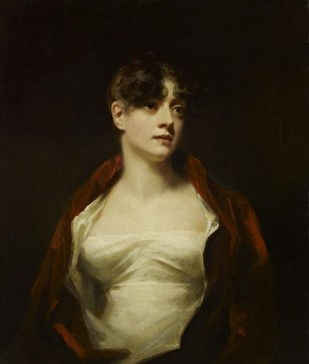
The present work is one of a series of highly expressive portraits of female sitters, all shown half-length and dramatically lit, painted by Raeburn in the later years of his life. They occupy an almost iconic position within Raeburn’s oeuvre with the most famous being the portrait of Margaritta Moncrieff (d. 1824) in the National Gallery of Scotland in Edinburgh (fig.1), which has been described as one of Raeburn’s best-loved portraits.[2] The heightened emotion of these works was achieved in no small part by the intensity of the background which necessitated the use of bitumen, an additive commonly used by artists at this date and which can cause the paint layers to distort and separate over time. Resultingly, works such as this example were often overpainted by subsequent owners in an attempt to create a more synthetic, even surface to the detriment of the overall composition and colouring. With the later layers of additional paint now removed, we are once again presented with a portrait of almost unparalleled charm and sensibility.
Raeburn was born in Edinburgh in 1756 and was orphaned at the age of six. He was later apprenticed to a jeweller and goldsmith before progressing into portrait painting – initially in watercolour on ivory and then in oils. It was not until his marriage to a wealthy widow, Ann Edgar, in 1780 that he received any formal training and in 1784 he moved to London and became a pupil of Reynolds. Wielding letters of introduction from his tutor, Raeburn travelled to Rome where he remained for two years before returning to Edinburgh where he established a successful studio practice. Some of his most imaginative works were painted at this date, including the double portrait of Robert (1769-1840) and Ronald Ferguson (1773-1841), more familiarly known as The Archers (fig.2), and he boasted an impressive roster of patrons such as Sir Walter Scott (1771-1832). From 1792 he exhibited at the Royal Academy and over the next thirty years he submitted fifty-three works for their annual exhibitions. Despite gaining a considerable reputation in England, Raeburn remained in Edinburgh where he laid the foundations for a new school of painting that influenced Scottish portraiture for the generations that followed. In 1823 his contributions were acknowledged when he received both a knighthood and the title of His Majesty's First Limner and Painter in Scotland.
[1] Coltman, V. (2013). Henry Raeburn's Portraits of Distant Sons in the Global British Empire. Art Bulletin, 95(2), 295.
[2] Sir Henry Raeburn, Margaritta MacDonald, Mrs Robert Scott Moncrieff. Available at: https://www.nationalgalleries.... (accessed: 7th September 2023)
Provenance
By descent to Ann Mander Barber, daughter of the sitter, and her husband Samuel Thomas Cooper;
By descent to Arthur Francis Cooper;
By descent to Col. Richard Francis Cooper (1892 – 1952);
Ms. Sylvia Mullen (according to a label on the reverse);
Sotheby’s, Los Angeles, 17 November 1980, lot 30;
Acquired by the previous owner from the above sale.
Exhibitions
D. Mackie, 'Raeburn life and art: The complete catalogue of the artist’s work', unpublished PhD diss., Edinburgh & Yale, vol. IV, p. 914, no. 764.
Literature
London, French Gallery, Pictures by Sir Henry Raeburn R.A., 1911, no. 7.
San Franciso Museum of Art (later Museum of Modern Art) (according to a label on the reverse).