English School
To view all current artworks for sale visit philipmould.com
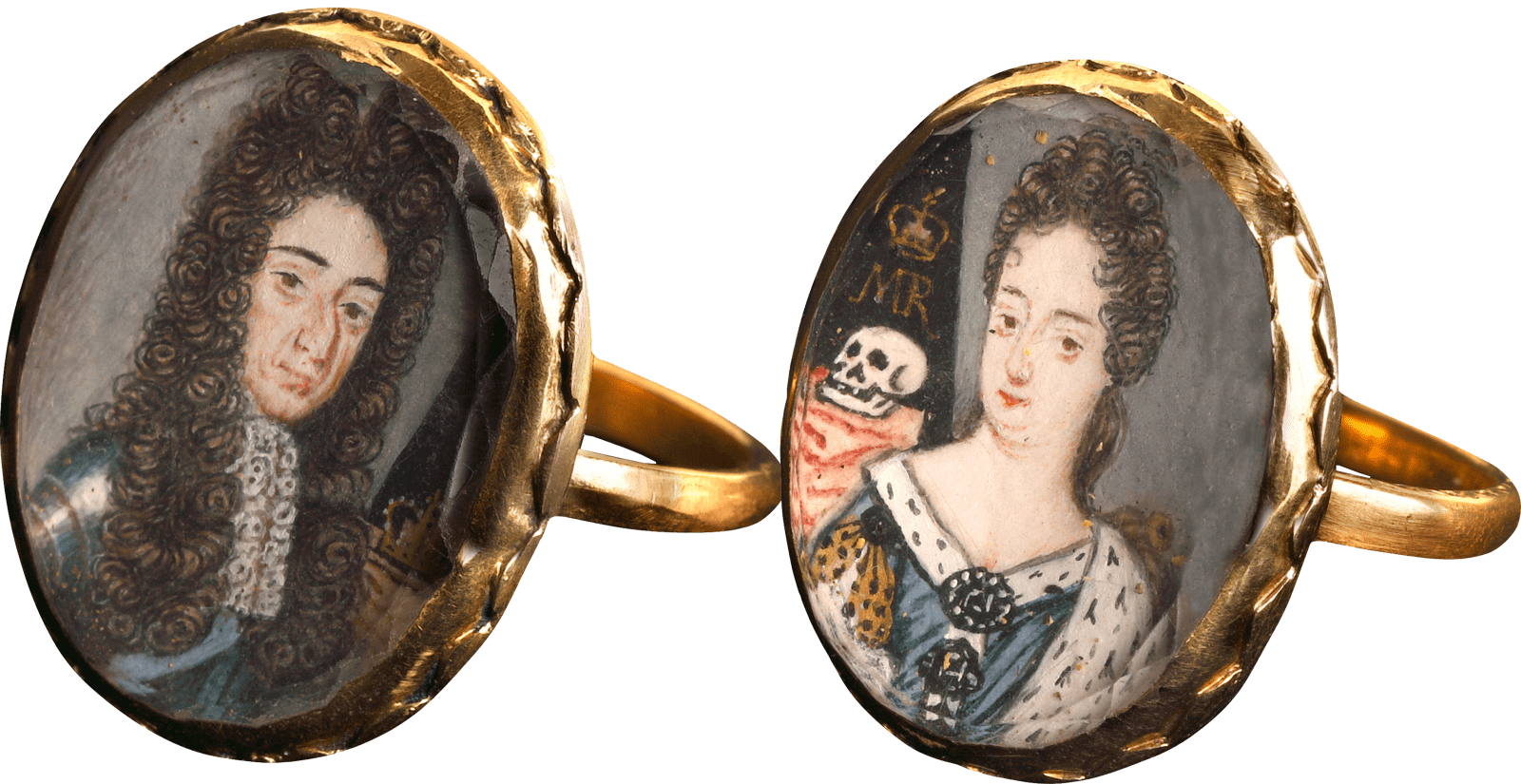
Although several finger rings depicting William and Mary survive (an almost identical example of the ‘Mary’ ring is in the collection at the British Museum, AF.1450), it is extremely rare for them to survive as a pair. These rings form part of a tradition for wearing images of Stuart monarchs, the tradition for which flourished from the execution of Charles I in 1649. Part political allegiance, part mourning jewellery, the ring proved love and devotion from the wearer toward their favoured monarch in a subtle manner. Such rings were particularly popular during times of political and religious upheaval, but they could also be worn during periods of national mourning and this pair likely date to shortly after the tragic, early death of Queen Mary from smallpox in December 1694.
The two images of the King and Queen would appear to derive from an engraving of the pair by Robert White (1645-1703) dating to circa 1689 but also relate to the portraits by Sir Godfrey Kneller painted in 1690/91 showing Mary in State robes. In the ring portraits, the artist has added a skull behind the figure of Mary, presumably in a reference to her death, as well as her initials ‘MR’ in gold; William is depicted with his crown on a table beside him.
After Mary’s death in 1694 -by which the King was devastated and which caused him to suspend, for example, the magnificent projects at Hampton Court which were being effected largely in her honour- William continued as king, although respecting Princess Anne, wife of Prince George of Denmark (1653-1708), as his successor, who waived her right to the throne during his lifetime. William’s reign as King of England was marked by a continued struggle against Louis XIV (1638-1715) in defence of the interests of the Dutch states, as well as in its initial stage the campaigns against James II who attempted to regain his throne through military action in Ireland, involving most famously his victory over King James’s forces at the Battle of the Boyne in 1690.