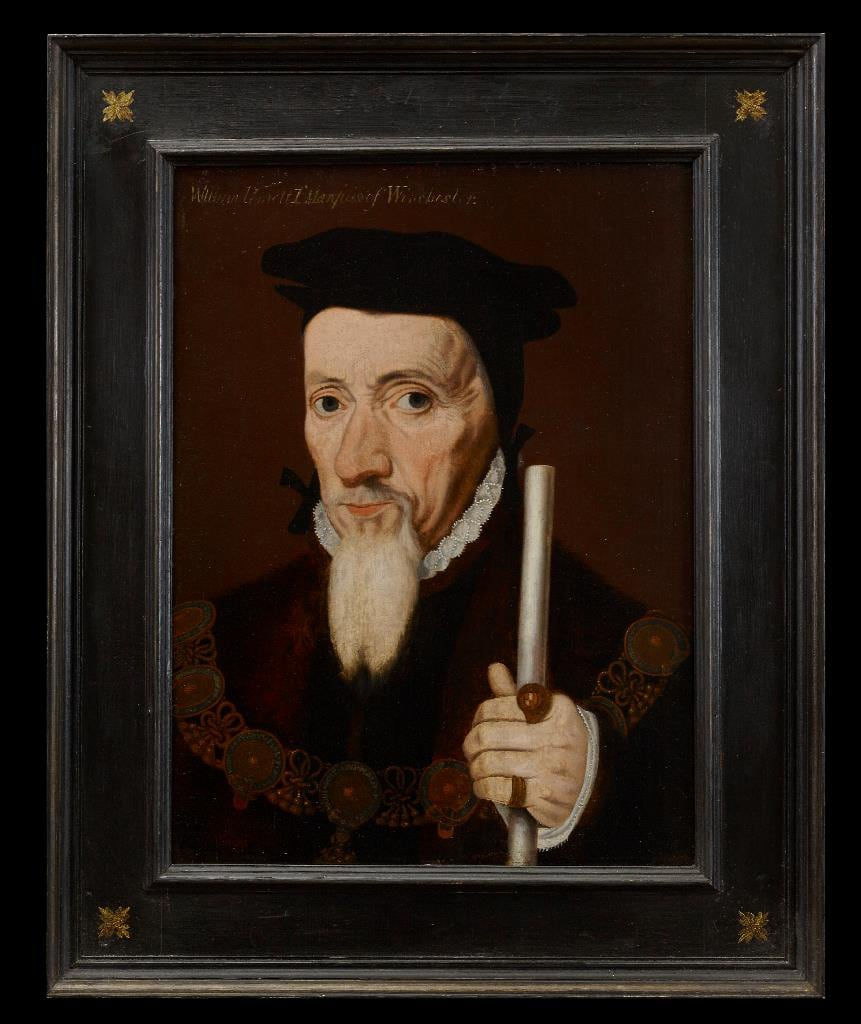
English School
Portrait of William Paulet, 1st Marquess of Winchester (1474/5-1572), c. 1560s
Oil on panel
17 1/8 x 13 ins. (43.5 x 33cm)
Philip Mould & Co.
To view all current artworks for sale visit philipmould.com
William Paulet, 1st Marquess of Winchester was one of the longest serving statesman of the late-Tudor period, whose cunning religious and political liquidity kept him in near constant favour throughout the turbulent reigns of four monarchs.
This early Elizabethan panel portrait was almost certainly painted in the 1560s and shows Paulet (or the Marquess of Winchester, as he was called by this date), holding the white wand of the Lord Treasurer, a position he held from 1550 until his death in 1572. He is also shown wearing the great collar and George of the Order of the Garter, with each section of the collar inscribed with the Garter motto Honi Soit Qui Mal Y Pense (‘Shame Be to Him Who Thinks Evil Of It’). As Lord Treasurer, Winchester was incredibly influential, and his portrait would have been in great demand amongst those eager to demonstrate support and allegiance.
William Paulet was the eldest son of Sir John Paulet of Basing, Hampshire and his wife Alice, daughter of Sir William Paulet of Hinton St George, Somerset. Details of Paulet’s early life are vague, although it has been suggested he trained in law. In 1511 Paulet was made sheriff of Hampshire, a county in which the family had thrived since the early fifteenth century, when Paulet’s great-grandfather married the coheir of Thomas Poynings, baron St John of Basing.
Paulet’s rise to prominence can be attributed to his friendship with Richard Fox, who held the illustrious seat of bishopric of Winchester, a short distance from Paulet’s estate in Basing. Through Fox, Paulet appears to have found favour with Cardinal Wolsey, who, on Fox’s recommendation, granted Paulet a commission in Southampton in 1517. Wolsey’s act of goodwill at the early stages of Paulet’s career is perhaps unexpected, not least because he received the opposite treatment himself at the hands of Paulet’s uncle, Sir Amyas Paulet, who, in 1500 when Wolsey was based in Limington, sent him to the stocks for being a nuisance.
The 1520s was a period of rapid progression for Paulet; he was knighted sometime between 1523-5 and on 5 January 1525 succeed his father. The following year he was appointed Master of the King’s Wards, a lucrative position which dealt with the dispersal of land and associated incomes
temporarily confiscated from heirs still in their minority. Paulet maintained his governance of wardships for twenty eight years, accumulating vast wealth and influence.
In 1532 Paulet was made Comptroller of the Royal Household and the following year was put to task reducing the household and power of the now styled ‘Dowager Princess’ Katherine of Aragon, along with daughter Mary. Upon the death of Katherine, Paulet was asked by Henry to oversee her internment in Peterborough Cathedral and the subsequent dispersal of her possessions. Although this brought Paulet into direct conflict with Mary, it seemed to have little effect on his career when she later became queen, and we can perhaps gauge, therefore, that delicacy and diplomacy were key characteristics of Paulet’s demeanour at this date.
In March 1539, possibly in recognition for his work during the trials of Anne Boleyn’s supposed lovers, he was made Baron St John. A few years later, on 6 May 1543 St John was installed as Knight of the Garter, and in 1545 was made Lord President of the Privy Council. Henry VIII’s trust in St John was evident, and on the king’s death he was made, along with fifteen peers, a regency guardian of Edward VI during his youth.
St John was a key supporter of Somerset as Lord Protector, though quickly allied himself with Warwick and Southampton when a successful coup seemed inevitable. In return for this ‘loyalty’ St John was made Earl of Wiltshire in January 1550 and in March was made Lord Treasurer. In October 1551 Wiltshire was made Marquess of Winchester.
On the death of Edward VI, Winchester initially supported Lady Jane Grey’s claim to the throne, although later, along with several members of the Privy Council, switched sides and pronounced Mary the rightful Queen. During Mary’s reign, Winchester retained his role as Lord Treasurer although resigned his wardships role and focussed, with little success it seems, on fiscal policies. Although certainly respected by Mary, Winchester was closely marked, and three of his estates received through the dissolution of the monasteries were returned, on Mary’s orders, to the bishopric of Winchester.
When Mary died and Elizabeth ascended to the throne, Winchester was once again retained in his role as Lord Treasurer and transformed the role into one of the most enviable and influential positions at court. Old age eventually forced Winchester into retirement in the summer of 1570, and he died on 10 March 1572 at Basing House.
Winchester’s likeness is known only through one portrait-type, of which the present work is a particularly fine example. Another, larger version is in the collection at the National Portrait Gallery, London [NPG 65] and shows Winchester half-length facing to the right and holding a piece of paper in his left hand. The identity of the artist who introduced this portrait-type is not known, although the tracing (or ‘pattern’) of the composition would have been circulated amongst artist’s workshops to ensure the demand for Winchester’s likeness was met. A study of the preparatory under drawing in the present work under infrared light reveals a thorough and complex understanding of the depiction of old age, and although much of this design would have been gleaned from the tracing, certain passages such as the creasing of the eyebrows, reveal the hand of a well-trained artist.
William Paulet, 1st Marquess of Winchester was one of the longest serving statesman of the late-Tudor period, whose cunning religious and political liquidity kept him in near constant favour throughout the turbulent reigns of four monarchs.
This early Elizabethan panel portrait was almost certainly painted in the 1560s and shows Paulet (or the Marquess of Winchester, as he was called by this date), holding the white wand of the Lord Treasurer, a position he held from 1550 until his death in 1572. He is also shown wearing the great collar and George of the Order of the Garter, with each section of the collar inscribed with the Garter motto Honi Soit Qui Mal Y Pense (‘Shame Be to Him Who Thinks Evil Of It’). As Lord Treasurer, Winchester was incredibly influential, and his portrait would have been in great demand amongst those eager to demonstrate support and allegiance.
William Paulet was the eldest son of Sir John Paulet of Basing, Hampshire and his wife Alice, daughter of Sir William Paulet of Hinton St George, Somerset. Details of Paulet’s early life are vague, although it has been suggested he trained in law. In 1511 Paulet was made sheriff of Hampshire, a county in which the family had thrived since the early fifteenth century, when Paulet’s great-grandfather married the coheir of Thomas Poynings, baron St John of Basing.
Paulet’s rise to prominence can be attributed to his friendship with Richard Fox, who held the illustrious seat of bishopric of Winchester, a short distance from Paulet’s estate in Basing. Through Fox, Paulet appears to have found favour with Cardinal Wolsey, who, on Fox’s recommendation, granted Paulet a commission in Southampton in 1517. Wolsey’s act of goodwill at the early stages of Paulet’s career is perhaps unexpected, not least because he received the opposite treatment himself at the hands of Paulet’s uncle, Sir Amyas Paulet, who, in 1500 when Wolsey was based in Limington, sent him to the stocks for being a nuisance.
The 1520s was a period of rapid progression for Paulet; he was knighted sometime between 1523-5 and on 5 January 1525 succeed his father. The following year he was appointed Master of the King’s Wards, a lucrative position which dealt with the dispersal of land and associated incomes
temporarily confiscated from heirs still in their minority. Paulet maintained his governance of wardships for twenty eight years, accumulating vast wealth and influence.
In 1532 Paulet was made Comptroller of the Royal Household and the following year was put to task reducing the household and power of the now styled ‘Dowager Princess’ Katherine of Aragon, along with daughter Mary. Upon the death of Katherine, Paulet was asked by Henry to oversee her internment in Peterborough Cathedral and the subsequent dispersal of her possessions. Although this brought Paulet into direct conflict with Mary, it seemed to have little effect on his career when she later became queen, and we can perhaps gauge, therefore, that delicacy and diplomacy were key characteristics of Paulet’s demeanour at this date.
In March 1539, possibly in recognition for his work during the trials of Anne Boleyn’s supposed lovers, he was made Baron St John. A few years later, on 6 May 1543 St John was installed as Knight of the Garter, and in 1545 was made Lord President of the Privy Council. Henry VIII’s trust in St John was evident, and on the king’s death he was made, along with fifteen peers, a regency guardian of Edward VI during his youth.
St John was a key supporter of Somerset as Lord Protector, though quickly allied himself with Warwick and Southampton when a successful coup seemed inevitable. In return for this ‘loyalty’ St John was made Earl of Wiltshire in January 1550 and in March was made Lord Treasurer. In October 1551 Wiltshire was made Marquess of Winchester.
On the death of Edward VI, Winchester initially supported Lady Jane Grey’s claim to the throne, although later, along with several members of the Privy Council, switched sides and pronounced Mary the rightful Queen. During Mary’s reign, Winchester retained his role as Lord Treasurer although resigned his wardships role and focussed, with little success it seems, on fiscal policies. Although certainly respected by Mary, Winchester was closely marked, and three of his estates received through the dissolution of the monasteries were returned, on Mary’s orders, to the bishopric of Winchester.
When Mary died and Elizabeth ascended to the throne, Winchester was once again retained in his role as Lord Treasurer and transformed the role into one of the most enviable and influential positions at court. Old age eventually forced Winchester into retirement in the summer of 1570, and he died on 10 March 1572 at Basing House.
Winchester’s likeness is known only through one portrait-type, of which the present work is a particularly fine example. Another, larger version is in the collection at the National Portrait Gallery, London [NPG 65] and shows Winchester half-length facing to the right and holding a piece of paper in his left hand. The identity of the artist who introduced this portrait-type is not known, although the tracing (or ‘pattern’) of the composition would have been circulated amongst artist’s workshops to ensure the demand for Winchester’s likeness was met. A study of the preparatory under drawing in the present work under infrared light reveals a thorough and complex understanding of the depiction of old age, and although much of this design would have been gleaned from the tracing, certain passages such as the creasing of the eyebrows, reveal the hand of a well-trained artist.
William Paulet, 1st Marquess of Winchester was one of the longest serving statesman of the late-Tudor period, whose cunning religious and political liquidity kept him in near constant favour throughout the turbulent reigns of four monarchs.
This early Elizabethan panel portrait was almost certainly painted in the 1560s and shows Paulet (or the Marquess of Winchester, as he was called by this date), holding the white wand of the Lord Treasurer, a position he held from 1550 until his death in 1572. He is also shown wearing the great collar and George of the Order of the Garter, with each section of the collar inscribed with the Garter motto Honi Soit Qui Mal Y Pense (‘Shame Be to Him Who Thinks Evil Of It’). As Lord Treasurer, Winchester was incredibly influential, and his portrait would have been in great demand amongst those eager to demonstrate support and allegiance.
William Paulet was the eldest son of Sir John Paulet of Basing, Hampshire and his wife Alice, daughter of Sir William Paulet of Hinton St George, Somerset. Details of Paulet’s early life are vague, although it has been suggested he trained in law. In 1511 Paulet was made sheriff of Hampshire, a county in which the family had thrived since the early fifteenth century, when Paulet’s great-grandfather married the coheir of Thomas Poynings, baron St John of Basing.
Paulet’s rise to prominence can be attributed to his friendship with Richard Fox, who held the illustrious seat of bishopric of Winchester, a short distance from Paulet’s estate in Basing. Through Fox, Paulet appears to have found favour with Cardinal Wolsey, who, on Fox’s recommendation, granted Paulet a commission in Southampton in 1517. Wolsey’s act of goodwill at the early stages of Paulet’s career is perhaps unexpected, not least because he received the opposite treatment himself at the hands of Paulet’s uncle, Sir Amyas Paulet, who, in 1500 when Wolsey was based in Limington, sent him to the stocks for being a nuisance.
The 1520s was a period of rapid progression for Paulet; he was knighted sometime between 1523-5 and on 5 January 1525 succeed his father. The following year he was appointed Master of the King’s Wards, a lucrative position which dealt with the dispersal of land and associated incomes temporarily confiscated from heirs still in their minority. Paulet maintained his governance of wardships for twenty eight years, accumulating vast wealth and influence.
In 1532 Paulet was made Comptroller of the Royal Household and the following year was put to task reducing the household and power of the now styled ‘Dowager Princess’ Katherine of Aragon, along with daughter Mary. Upon the death of Katherine, Paulet was asked by Henry to oversee her internment in Peterborough Cathedral and the subsequent dispersal of her possessions. Although this brought Paulet into direct conflict with Mary, it seemed to have little effect on his career when she later became queen, and we can perhaps gauge, therefore, that delicacy and diplomacy were key characteristics of Paulet’s demeanour at this date.
In March 1539, possibly in recognition for his work during the trials of Anne Boleyn’s supposed lovers, he was made Baron St John. A few years later, on 6 May 1543 St John was installed as Knight of the Garter, and in 1545 was made Lord President of the Privy Council. Henry VIII’s trust in St John was evident, and on the king’s death he was made, along with fifteen peers, a regency guardian of Edward VI during his youth.
St John was a key supporter of Somerset as Lord Protector, though quickly allied himself with Warwick and Southampton when a successful coup seemed inevitable. In return for this ‘loyalty’ St John was made Earl of Wiltshire in January 1550 and in March was made Lord Treasurer. In October 1551 Wiltshire was made Marquess of Winchester.
On the death of Edward VI, Winchester initially supported Lady Jane Grey’s claim to the throne, although later, along with several members of the Privy Council, switched sides and pronounced Mary the rightful Queen. During Mary’s reign, Winchester retained his role as Lord Treasurer although resigned his wardships role and focussed, with little success it seems, on fiscal policies. Although certainly respected by Mary, Winchester was closely marked, and three of his estates received through the dissolution of the monasteries were returned, on Mary’s orders, to the bishopric of Winchester.
When Mary died and Elizabeth ascended to the throne, Winchester was once again retained in his role as Lord Treasurer and transformed the role into one of the most enviable and influential positions at court. Old age eventually forced Winchester into retirement in the summer of 1570, and he died on 10 March 1572 at Basing House.
Winchester’s likeness is known only through one portrait-type, of which the present work is a particularly fine example. Another, larger version is in the collection at the National Portrait Gallery, London [NPG 65] and shows Winchester half-length facing to the right and holding a piece of paper in his left hand. The identity of the artist who introduced this portrait-type is not known, although the tracing (or ‘pattern’) of the composition would have been circulated amongst artist’s workshops to ensure the demand for Winchester’s likeness was met. A study of the preparatory under drawing in the present work under infrared light reveals a thorough and complex understanding of the depiction of old age, and although much of this design would have been gleaned from the tracing, certain passages such as the creasing of the eyebrows, reveal the hand of a well-trained artist.
This early Elizabethan panel portrait was almost certainly painted in the 1560s and shows Paulet (or the Marquess of Winchester, as he was called by this date), holding the white wand of the Lord Treasurer, a position he held from 1550 until his death in 1572. He is also shown wearing the great collar and George of the Order of the Garter, with each section of the collar inscribed with the Garter motto Honi Soit Qui Mal Y Pense (‘Shame Be to Him Who Thinks Evil Of It’). As Lord Treasurer, Winchester was incredibly influential, and his portrait would have been in great demand amongst those eager to demonstrate support and allegiance.
William Paulet was the eldest son of Sir John Paulet of Basing, Hampshire and his wife Alice, daughter of Sir William Paulet of Hinton St George, Somerset. Details of Paulet’s early life are vague, although it has been suggested he trained in law. In 1511 Paulet was made sheriff of Hampshire, a county in which the family had thrived since the early fifteenth century, when Paulet’s great-grandfather married the coheir of Thomas Poynings, baron St John of Basing.
Paulet’s rise to prominence can be attributed to his friendship with Richard Fox, who held the illustrious seat of bishopric of Winchester, a short distance from Paulet’s estate in Basing. Through Fox, Paulet appears to have found favour with Cardinal Wolsey, who, on Fox’s recommendation, granted Paulet a commission in Southampton in 1517. Wolsey’s act of goodwill at the early stages of Paulet’s career is perhaps unexpected, not least because he received the opposite treatment himself at the hands of Paulet’s uncle, Sir Amyas Paulet, who, in 1500 when Wolsey was based in Limington, sent him to the stocks for being a nuisance.
The 1520s was a period of rapid progression for Paulet; he was knighted sometime between 1523-5 and on 5 January 1525 succeed his father. The following year he was appointed Master of the King’s Wards, a lucrative position which dealt with the dispersal of land and associated incomes temporarily confiscated from heirs still in their minority. Paulet maintained his governance of wardships for twenty eight years, accumulating vast wealth and influence.
In 1532 Paulet was made Comptroller of the Royal Household and the following year was put to task reducing the household and power of the now styled ‘Dowager Princess’ Katherine of Aragon, along with daughter Mary. Upon the death of Katherine, Paulet was asked by Henry to oversee her internment in Peterborough Cathedral and the subsequent dispersal of her possessions. Although this brought Paulet into direct conflict with Mary, it seemed to have little effect on his career when she later became queen, and we can perhaps gauge, therefore, that delicacy and diplomacy were key characteristics of Paulet’s demeanour at this date.
In March 1539, possibly in recognition for his work during the trials of Anne Boleyn’s supposed lovers, he was made Baron St John. A few years later, on 6 May 1543 St John was installed as Knight of the Garter, and in 1545 was made Lord President of the Privy Council. Henry VIII’s trust in St John was evident, and on the king’s death he was made, along with fifteen peers, a regency guardian of Edward VI during his youth.
St John was a key supporter of Somerset as Lord Protector, though quickly allied himself with Warwick and Southampton when a successful coup seemed inevitable. In return for this ‘loyalty’ St John was made Earl of Wiltshire in January 1550 and in March was made Lord Treasurer. In October 1551 Wiltshire was made Marquess of Winchester.
On the death of Edward VI, Winchester initially supported Lady Jane Grey’s claim to the throne, although later, along with several members of the Privy Council, switched sides and pronounced Mary the rightful Queen. During Mary’s reign, Winchester retained his role as Lord Treasurer although resigned his wardships role and focussed, with little success it seems, on fiscal policies. Although certainly respected by Mary, Winchester was closely marked, and three of his estates received through the dissolution of the monasteries were returned, on Mary’s orders, to the bishopric of Winchester.
When Mary died and Elizabeth ascended to the throne, Winchester was once again retained in his role as Lord Treasurer and transformed the role into one of the most enviable and influential positions at court. Old age eventually forced Winchester into retirement in the summer of 1570, and he died on 10 March 1572 at Basing House.
Winchester’s likeness is known only through one portrait-type, of which the present work is a particularly fine example. Another, larger version is in the collection at the National Portrait Gallery, London [NPG 65] and shows Winchester half-length facing to the right and holding a piece of paper in his left hand. The identity of the artist who introduced this portrait-type is not known, although the tracing (or ‘pattern’) of the composition would have been circulated amongst artist’s workshops to ensure the demand for Winchester’s likeness was met. A study of the preparatory under drawing in the present work under infrared light reveals a thorough and complex understanding of the depiction of old age, and although much of this design would have been gleaned from the tracing, certain passages such as the creasing of the eyebrows, reveal the hand of a well-trained artist.
Provenance
Probably Earls of Poulett, Hinton St George, Somerset;Sotheby’s, London, 11 July 1984, lot 176;
Private collection, UK