John Smart
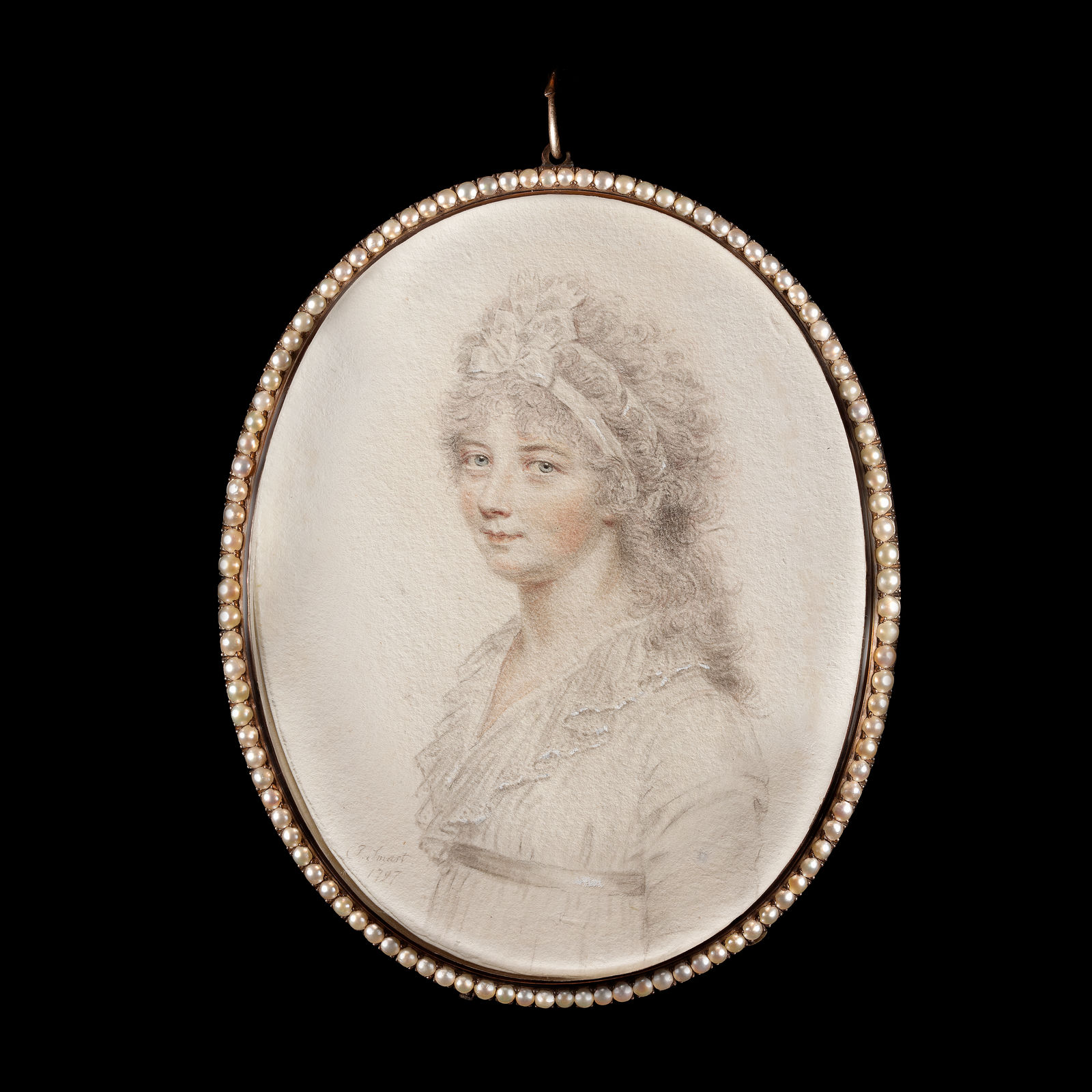
Mrs. Parker of Bath, wearing white muslin dress and two bows of white silk ribbon in her powdered hair, 1797
Watercolour on paper in later gold frame with border of split pearls
Oval, 3 ½ in. (90 mm) high
Signed in full and dated ‘J. Smart/1797’ lower left
Philip Mould & Company
This drawing by Smart of a ‘Mrs Parker’ is unusually signed with his full name and dated. This may indicate that this is one of Smart’s finished drawings – known...
This drawing by Smart of a ‘Mrs Parker’ is unusually signed with his full name and dated. This may indicate that this is one of Smart’s finished drawings – known as a ‘cabinet drawing’ – which would have been commissioned by the client. By this point in Smart’s career, having been back in London from India for several years (he returned in 1795), he offered his patrons an alternative to the traditional portrait miniature on ivory in the form of a finished drawing. Already known for his skill as a draughtsman, these alternative forms of portable portraiture where likely less expensive – larger, yet equally elegant. Lindsay Stainton suggests that he may have been ‘influenced by contemporary French portrait drawings and engravings, and shows his ability to adapt his style to the neoclassical sensibilities of the period’.
Here, the sitter ‘Mrs. Parker’ wears the new fashionable female silhouette of the last years of the eighteenth century. The cotton chemise dress had been in fashion from the early 1780s, but now the neckline was changed to a ‘V’ shape and bodice gathered. Although the waistline was usually slightly raised, in this portrait it is higher than normal and may indicate that ‘Mrs. Parker’ was expecting a child. One possible candidate for ‘Mrs. Parker’ of Bath is Eliza Peters Washington Pallmer (1777-1858), who married, as his second wife, Thomas John Parker, of the Royal Crescent Bath. The couple married in 1796, the year before this portrait was drawn, and had three children. A portrait of ‘Thomas John Parker’ was painted by Smart in 1798.
By 1799, Smart’s clientele came from the wealthy merchant classes. Nobility and royalty, on the other hand, flocked to the flamboyant and flattering Royal Academician Richard Cosway for their likenesses. By the end of the century, Smart had begun to train his son, also called John (1776-1809). There survive copies of drawings by Holbein, carefully drawn and dated to the late 1790s by John Smart Junior.
Although many wealthy families succumbed to the modish miniatures painted by Cosway and his followers, there can have been few artists available who were able to provide a more accurate likeness of the ‘Mrs. Parker’ seen here.
[1] E. Rutherford, L. Hendra, L. Stainton, H. Williams, ‘John Smart; A Genius Magnified’, Philip Mould Gallery, exhibition catalogue, 2014, p. 106.
[2] Sold Sotheby’s, London, 23 September 2021, lot 229.
Here, the sitter ‘Mrs. Parker’ wears the new fashionable female silhouette of the last years of the eighteenth century. The cotton chemise dress had been in fashion from the early 1780s, but now the neckline was changed to a ‘V’ shape and bodice gathered. Although the waistline was usually slightly raised, in this portrait it is higher than normal and may indicate that ‘Mrs. Parker’ was expecting a child. One possible candidate for ‘Mrs. Parker’ of Bath is Eliza Peters Washington Pallmer (1777-1858), who married, as his second wife, Thomas John Parker, of the Royal Crescent Bath. The couple married in 1796, the year before this portrait was drawn, and had three children. A portrait of ‘Thomas John Parker’ was painted by Smart in 1798.
By 1799, Smart’s clientele came from the wealthy merchant classes. Nobility and royalty, on the other hand, flocked to the flamboyant and flattering Royal Academician Richard Cosway for their likenesses. By the end of the century, Smart had begun to train his son, also called John (1776-1809). There survive copies of drawings by Holbein, carefully drawn and dated to the late 1790s by John Smart Junior.
Although many wealthy families succumbed to the modish miniatures painted by Cosway and his followers, there can have been few artists available who were able to provide a more accurate likeness of the ‘Mrs. Parker’ seen here.
[1] E. Rutherford, L. Hendra, L. Stainton, H. Williams, ‘John Smart; A Genius Magnified’, Philip Mould Gallery, exhibition catalogue, 2014, p. 106.
[2] Sold Sotheby’s, London, 23 September 2021, lot 229.
Provenance
Lilian Mary Dyer, née Bose (1871-1955), a great-granddaughter of the artist; Christie's, London, 26 November 1937, lot 44;
Frédéric Lauffer Collection, Paris (by 1956);
Private Collection, USA.
Exhibitions
Frédéric
Lauffer Collection, Paris, in Geneva, in 1956, no.417, p. 108.
Literature
Foskett, D., (1964) John Smart, The Man and his Miniatures. London: Cory, Adams and Mackay, p. 72.