Dod Procter
Further images


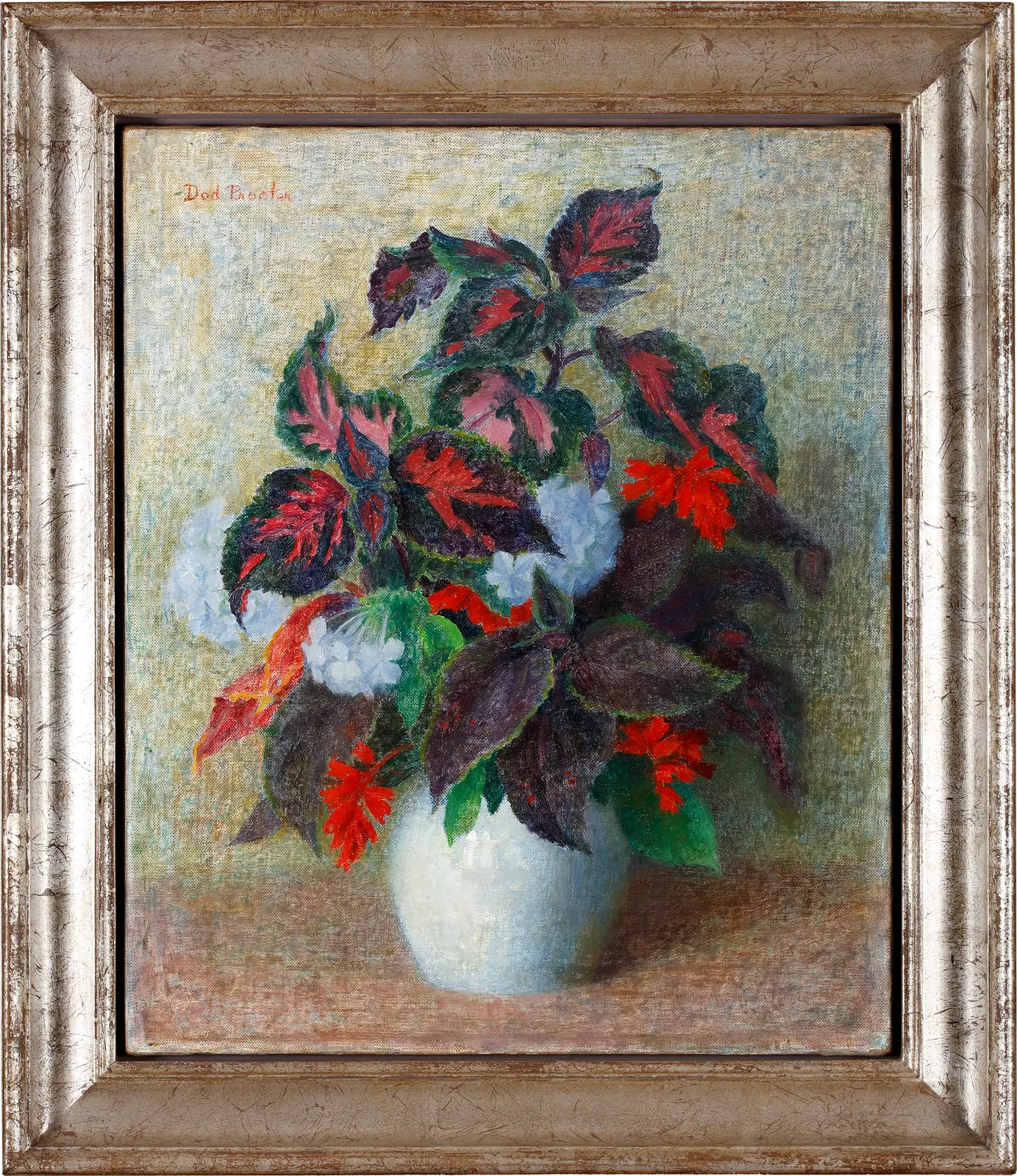
This bold still-life was painted by Dod Procter, one of the early twentieth century's most prominent British female artists.
By the mid-1920s Dod had become a household name and was gaining considerable recognition as a painter of portraits, figure studies, and still-lifes. In 1927, her monumental work Morning was exhibited at the Royal Academy where it was voted ‘Picture of the Year’ and acquired for the nation by the Daily Mail. It was subsequently exhibited in New York and then toured around Britain before being presented to the Tate Gallery where it remains on display today.
It was Dod’s highly idiosyncratic style coupled with her nuanced understanding of colour that caught the attention of the critics. She painted her female subjects with great delicacy and sincerity, and it was often remarked that the rounded smoothness of their features was more reminiscent of carved stone than painted canvas.
For an artist like Dod, who tended to avoid romanticism and embrace close observation, still-life was an obvious and rewarding genre to explore. Throughout the fifty-three years she exhibited at the Royal Academy, Dod showed around sixty-five still-life works, ranging from simple studies of objects on a table to large and ambitious studies of flowers within interiors. Her early still-life works, such as Bella Donna Lilies (1924) and Tulips (1926) are notable for their clarity of design and precision of form combined with a bold use of deep, saturated colour. Her later works, such as the present example, were painted in a softer style with a greater emphasis on surface texture.
The transition from the earlier, more literal style of painting to the softer, more impressionist approach seen in the present work came as a result of personal loss. In 1935, Dod’s husband Ernest died unexpectedly of a heart attack on a train whilst travelling from London to Glasgow. Dod was devastated – not only did they enjoy a close relationship but also a professional one, often exhibiting together in joint exhibitions around the country. Ernest was by all accounts a calm, measured man which was reflected in his art and, to an extent, influenced Dod’s work too. With Ernest now gone, Dod explored a new style of working which was more pointillist in a manner with a thinner application of paint. She would also experiment with surface texture, sometimes manipulating the fresh paint layers with a damp cloth and on occasion scratching the surface to create a sense of movement.
Still-life with Flowers in a Vase is typical of Dod’s mature style from the 1950s. Painting using multiple layers of thin paint in her well-established pointillist manner, she has painted the flowers as if viewed through a soft-focus lens. Soon after this work was painted it was either given to or acquired by Joan Manning-Sanders, a fellow artist and family friend whose walls it adorned for many years.
Provenance
From the estate of Joan Manning Sanders;Bequeathed by the above to the mother of the previous owner.